InternW0
A Foundational Physical World Model
for Efficient Real-World Interactions


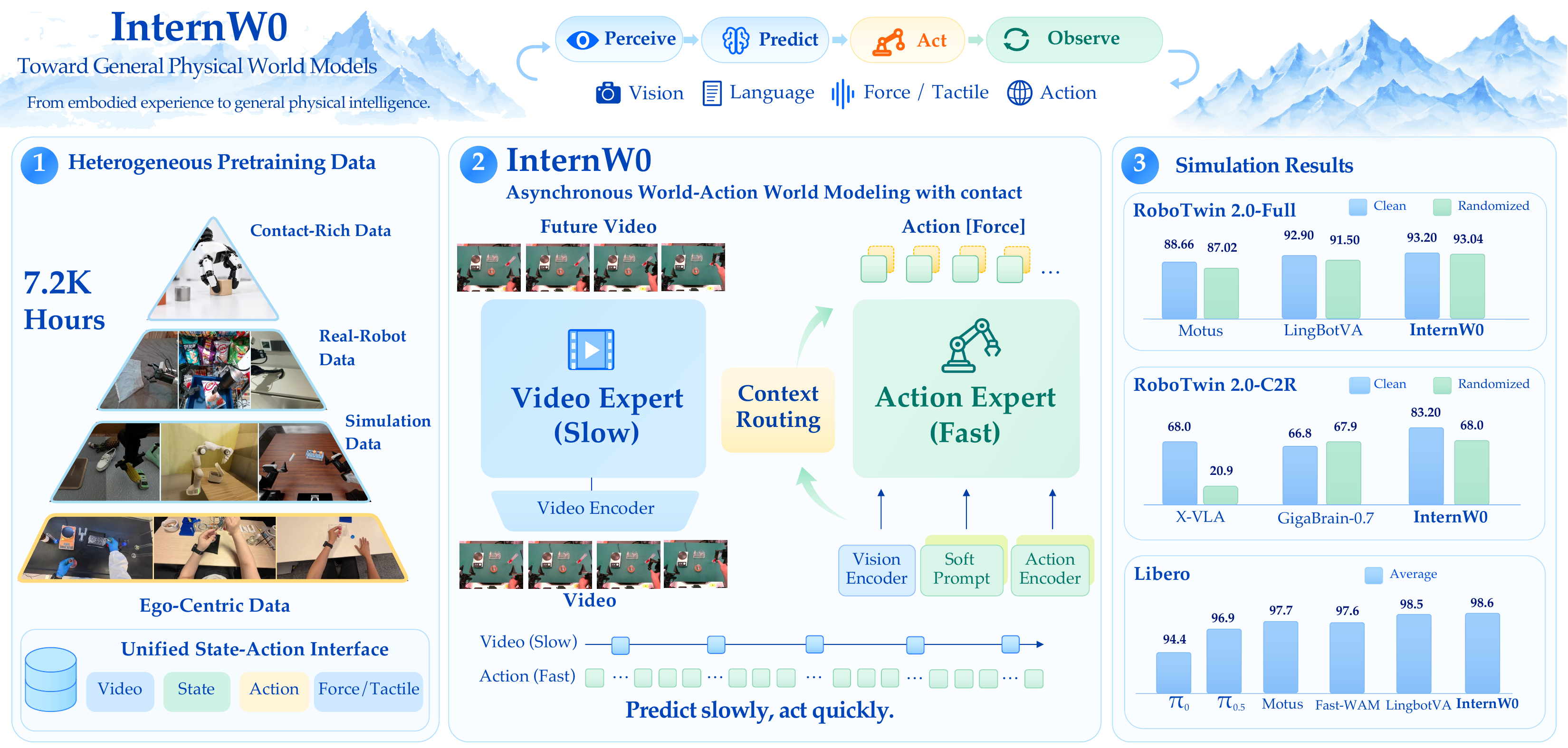
98.6%
LIBERO average
Mean success rate across all four task suites.93.12%
RoboTwin 2.0-Full
Average success across clean and randomized settings.75.60%
Clean2Random average
Clean-only post-training, evaluated on both scene settings.16.47 Hz
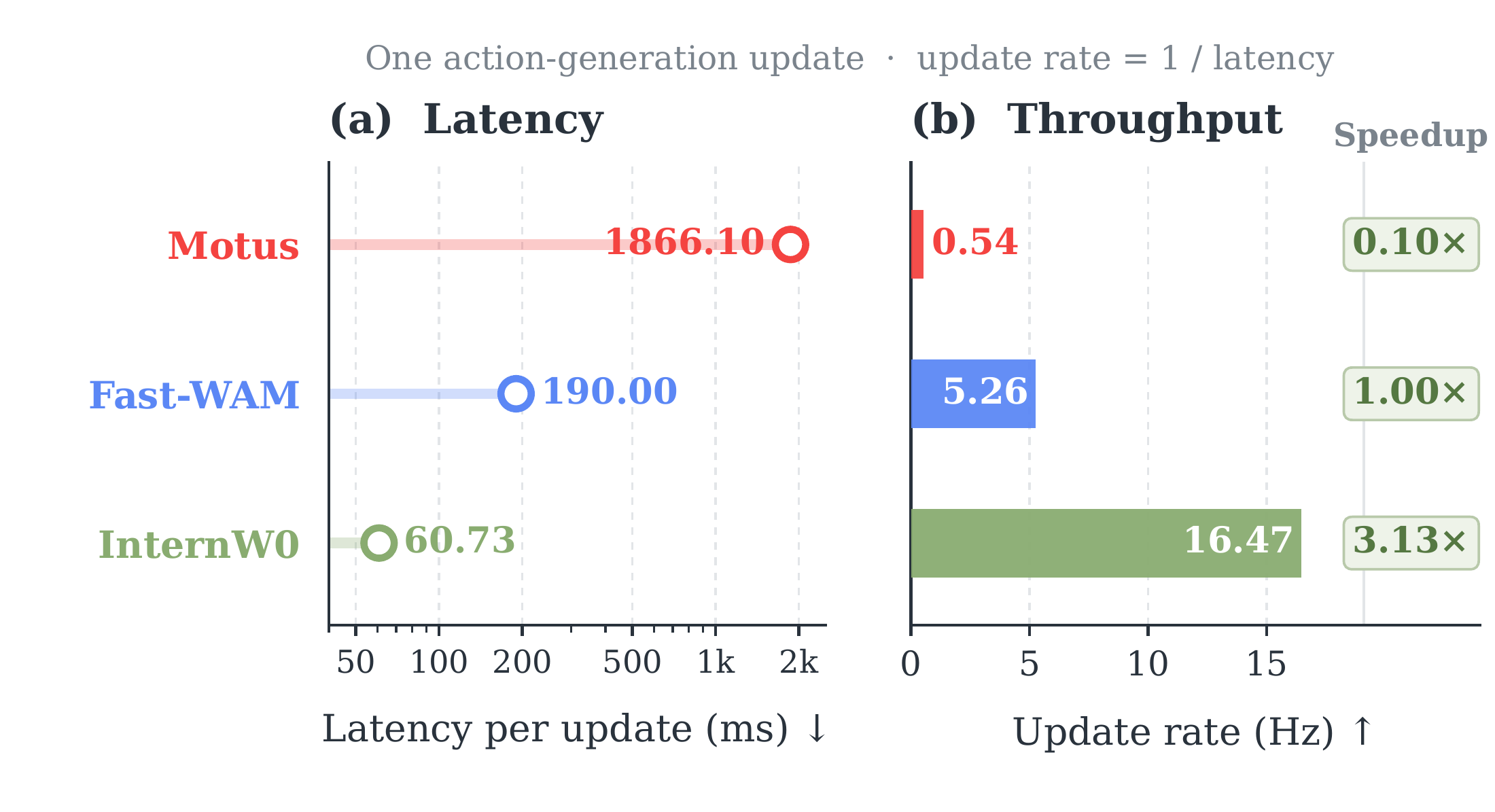
Model-side policy updates
60.73 ms per action update on RTX 5090D; video prediction runs asynchronously.Introduction
A Quick Overview of InternW0
See InternW0 carry out a multi-stage laboratory workflow before exploring the architecture, training data, and evaluation results.
Model
Asynchronous video–action modeling with contact-aware control
InternW0 uses a mixture-of-transformers backbone with separate video and action experts. Observation-conditioned context routing keeps longer-horizon predictions useful as new visual and physical feedback arrives.
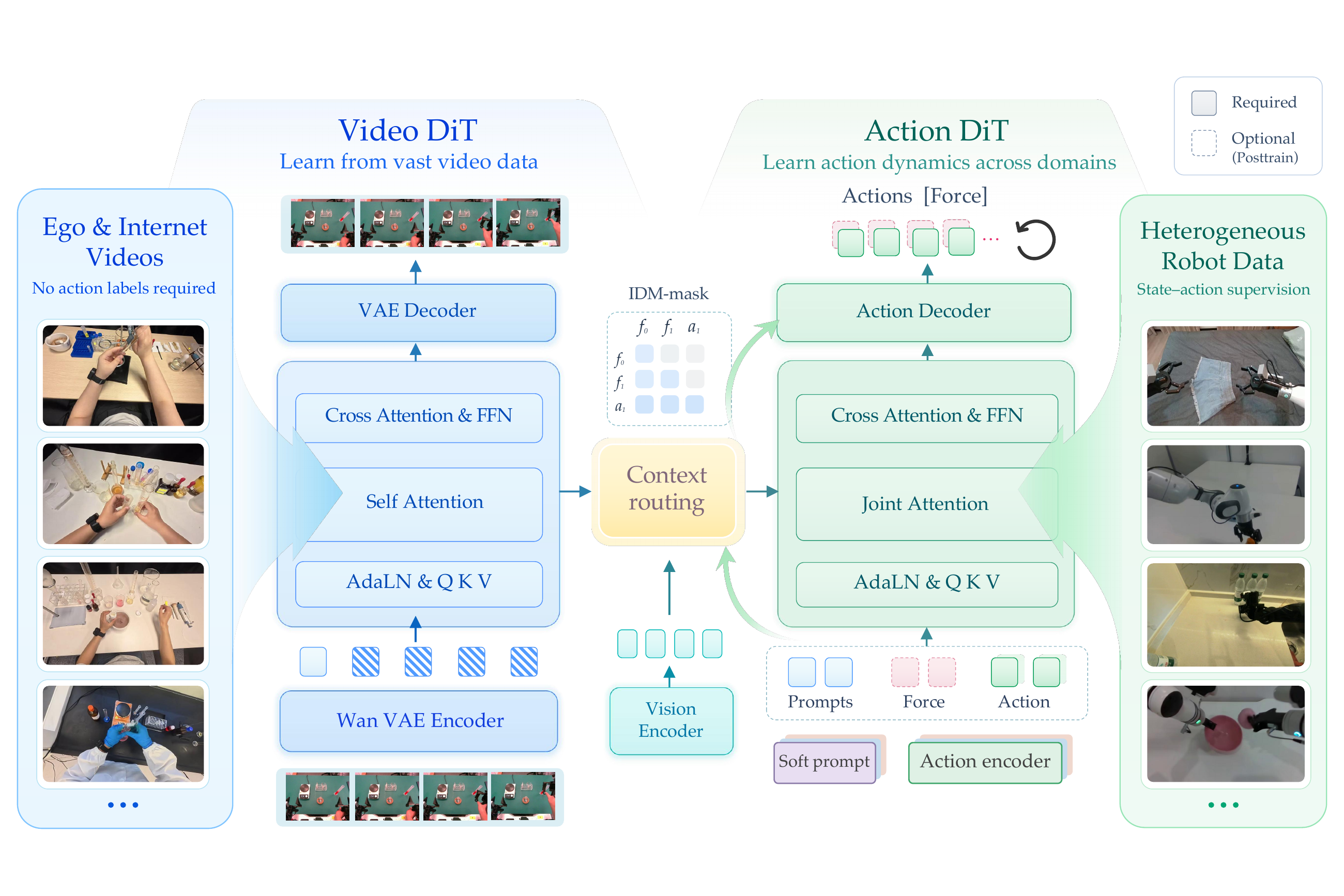
Joint video–action flow matching learns future visual dynamics and continuous control. A frozen Wan VAE encodes video, while a frozen DINOv3 encoder supplies current visual observations. Robot trajectories supervise both experts; egocentric videos train the video pathway without action labels. Domain-specific interfaces and soft prompts support heterogeneous embodiments, with force and tactile channels added during contact-aware post-training.
Data
7,233.5 hours across 25 training domains
Seven datasets combine real-robot trajectories, simulated manipulation, and egocentric laboratory video. A unified 37-dimensional state–action interface and validity masks accommodate different embodiments, while square-root domain sampling balances the training mixture.

| Source | Type | Domains | Hours | Episodes |
|---|---|---|---|---|
| InternData-A1 | Simulated | 6 | 3,494.3 | 568,194 |
| AgibotWorld | Real | 2 | 2,620.0 | 158,380 |
| RoboCOIN | Real | 13 | 438.1 | 59,952 |
| Galaxea | Real | 1 | 314.9 | 15,362 |
| MolmoAct | Real | 1 | 70.3 | 3,424 |
| RoboDojo | Simulated | 1 | 20.5 | 3,465 |
| Source | Hours | Episodes | Supervision |
|---|---|---|---|
| EgoLab | 275.4 | 3,192 | Future-video prediction without robot action labels |
Benchmarks
Strong single-arm manipulation and bimanual generalization
LIBERO evaluates 40 single-arm tasks across spatial, object, goal, and long-horizon suites. RoboTwin 2.0 covers 50 bimanual tasks, with Full and Clean2Random protocols separating in-domain adaptation from generalization to unseen randomized scenes.
| Benchmark | Metric | InternW0 |
|---|---|---|
| Average success rate | 98.6% | |
| Average success rate | 93.12% | |
| Average success rate | 75.60% |
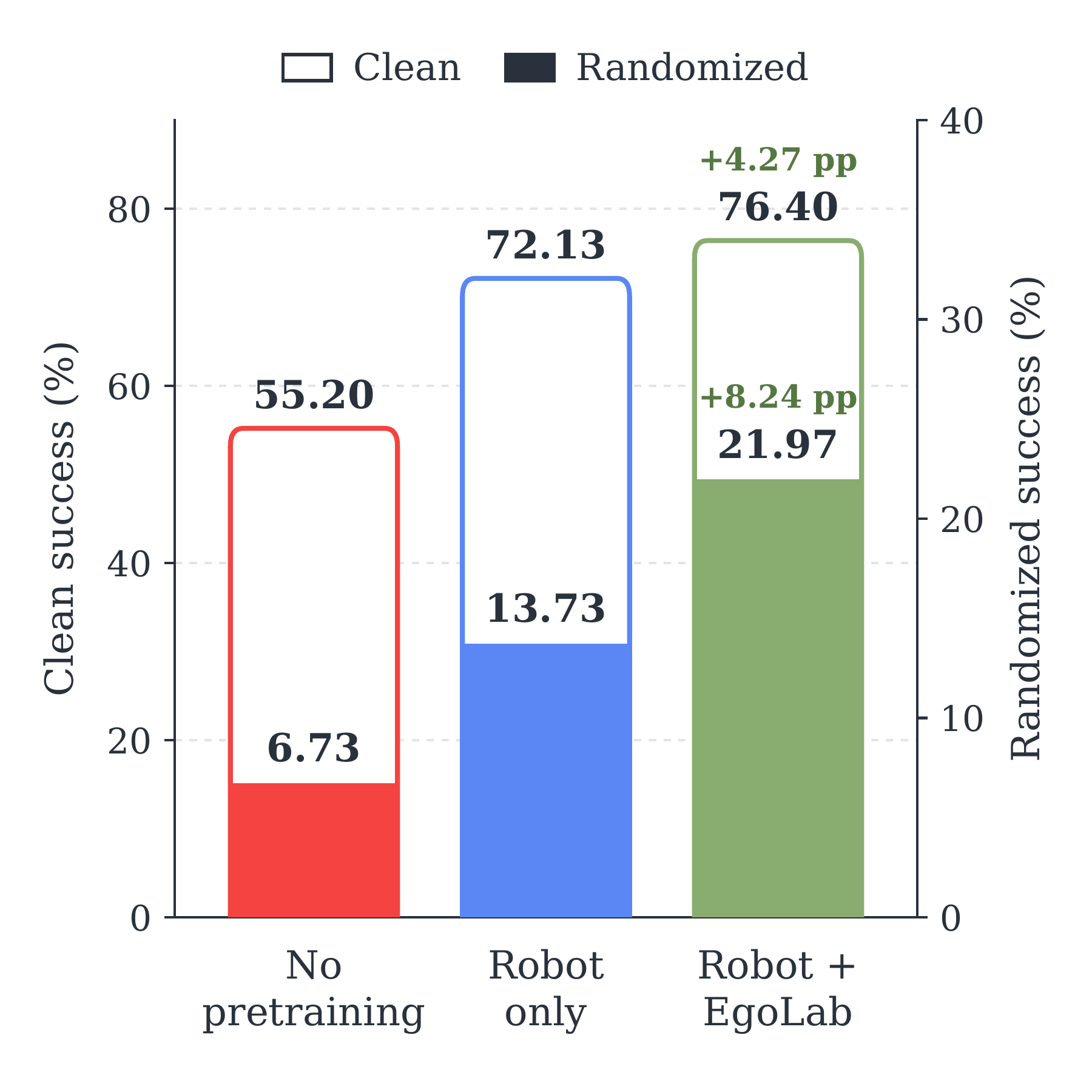
Egocentric video improves transfer
Efficient action updates
Experiments
From everyday manipulation to scientific workflows
Five real-world tasks test instruction following, object discrimination, long-horizon coordination, and contact-aware tool use. Four use a dual-arm platform; quantitative pipetting uses a 20-DoF dexterous hand on a 7-DoF arm with hybrid force–position control.

The real-world suite spans Make Sandwich, Pick Industrial Parts, Sort Tubes, MoF Experiments, and Quantitative Pipetting.
- Make Sandwich
- Pick up two bread slices and a piece of meat, then stack them in the prescribed order.
- Pick Industrial Parts
- Identify industrial parts and place each one into its matching box.
- Sort Tubes
- Follow an instruction specifying the arm, tube color, and destination box.
- MoF Experiments
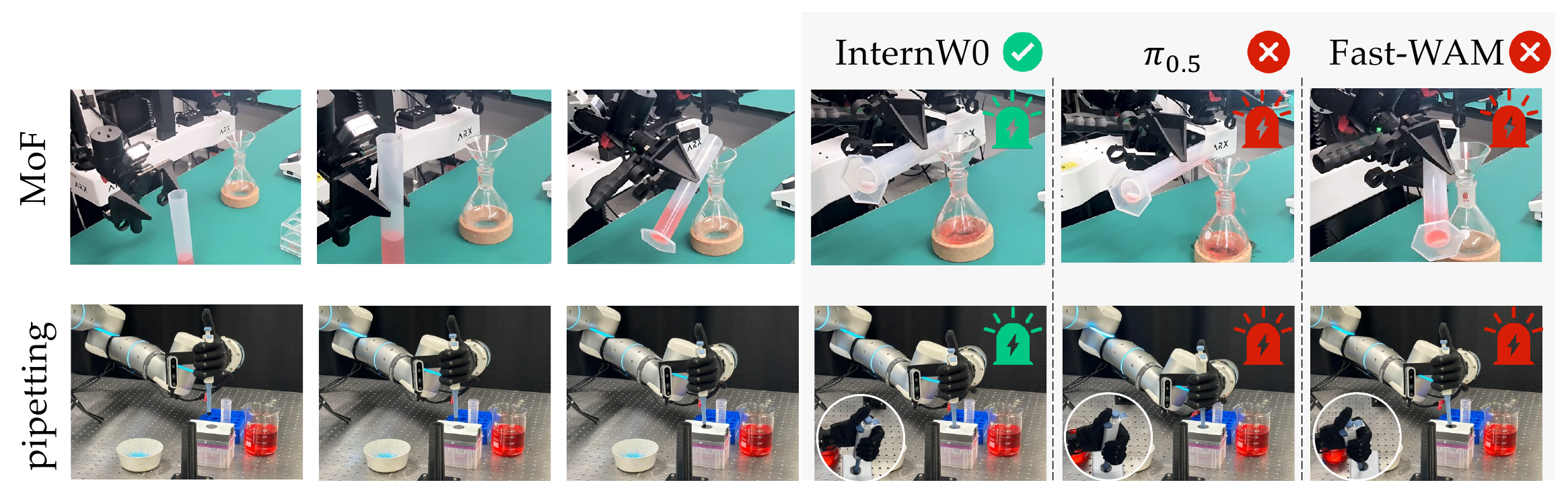
- Complete 15 ordered subtasks for solution preparation, including pouring, funnel removal, flask transfer, stopper insertion, and stirring.
- Quantitative Pipetting
- Coordinate five stages of dexterous tool use: pickup and reorientation, tip attachment, aspiration, dispensing, and tip ejection and return.
Real-world results
| Method | Make Sandwich · SR | Pick Industrial Parts · SR | Sort Tubes · SR | MoF · Progress | Pipetting · Progress |
|---|---|---|---|---|---|
| π0.5 | 73.3 | 53.1 | 86.7 | 50.2 | 46.7 |
| Fast-WAM | 40.0 | 50.6 | 66.7 | 10.7 | 18.7 |
| InternW0 | 73.3 | 82.7 | 88.9 | 68.4 | 65.3 |
Everyday and industrial manipulation
Dual-arm demonstrations of ordered assembly, part sorting, and language-conditioned tube selection.
Make Sandwich
Pick Industrial Parts
Sort Tubes
MoF Experiments
Close-up views of flask placement, stopper insertion, and stirrer operation within the 15-stage solution-preparation workflow.
Flask placement
Stopper insertion & stirring
Quantitative Pipetting
A dexterous hand coordinates pipette pickup, tip attachment, aspiration, dispensing, and tip ejection with force-aware control.
Quantitative Pipetting
MoF Experiments — subtask results
| Subtask | π0.5 | Fast-WAM | InternW0 |
|---|---|---|---|
| 1 · Pick up funnel from rack | 100.0 | 100.0 | 100.0 |
| 2 · Insert funnel into flask | 100.0 | 46.7 | 100.0 |
| 3 · Pick up graduated cylinder | 100.0 | 13.3 | 93.3 |
| 4 · Pour liquid into flask via funnel | 73.3 | 0.0 | 80.0 |
| 5 · Place graduated cylinder back | 73.3 | 0.0 | 80.0 |
| 6 · Hold flask steady on platform | 73.3 | 0.0 | 80.0 |
| 7 · Pick up funnel from flask | 73.3 | 0.0 | 80.0 |
| 8 · Insert funnel into rack hole | 46.7 | 0.0 | 66.7 |
| 9 · Return to initial position | 46.7 | 0.0 | 66.7 |
| 10 · Place flask onto stirrer | 33.3 | 0.0 | 66.7 |
| 11 · Pick up stopper from rack | 6.7 | 0.0 | 66.7 |
| 12 · Insert stopper into flask | 6.7 | 0.0 | 66.7 |
| 13 · Press left button of stirrer | 6.7 | 0.0 | 26.7 |
| 14 · Press right button of stirrer | 6.7 | 0.0 | 26.7 |
| 15 · Return to initial position | 6.7 | 0.0 | 26.7 |
| Overall progress rate | 50.2 | 10.7 | 68.4 |
Subtask success rates and overall progress rate (%) from Table 6. Overall progress is the fraction of subtasks completed correctly and in order.
Quantitative Pipetting — subtask results
| Subtask | π0.5 | Fast-WAM | InternW0 |
|---|---|---|---|
| 1 · Pickup & reorientation | 93.3 | 46.7 | 86.7 |
| 2 · Tip attachment | 40.0 | 13.3 | 66.7 |
| 3 · Liquid aspiration | 33.3 | 13.3 | 66.7 |
| 4 · Liquid dispensing | 33.3 | 13.3 | 60.0 |
| 5 · Tip ejection & return | 33.3 | 6.7 | 46.7 |
| Overall progress rate | 46.7 | 18.7 | 65.3 |
Subtask success rates and overall progress rate (%) from Table 7. Contact-aware post-training combines force history with visual and proprioceptive observations.
Contact-aware manipulation
Citation
BibTeX
@misc{cai2026internw0foundationalphysicalworld,
  title         = {InternW0: A Foundational Physical World Model for Efficient Real-World Interactions},
  author        = {Jisong Cai and Yao Mu and Ganlin Yang and Zhe Cao and Zhangzheng Tu and Xing Gao
                   and Kailin Li and Xinyu Zhan and Lixin Yang and Yangkun Zhu and Haoxiang Ma and Ming Zhou
                   and Qiaojun Yu and Yufei Xue and Liqun He and Yifei Yao and Yifan Zhu and Long Ling
                   and Bingqi Jiang and Haoyu Guo and Xueyue Zhu and Bowen Zhou and Bin Zhao
                   and Tianfan Xue and Chunhua Shen and Weinan Zhang},
  year          = {2026},
  eprint        = {2609.27656},
  archivePrefix = {arXiv},
  primaryClass  = {cs.RO},
  url           = {https://arxiv.org/abs/2609.27656}
}