Perceive
Estimate physical states from vision, touch, force, proprioception, and other sensing modalities.
Forthcoming monograph · Preprint coming soon
Concepts, Techniques, and Challenges

A monograph on intelligence that perceives, models, and acts upon the physical world, connecting technical foundations with embodied systems and the challenges of Physical AGI.
Preprint coming soon · Publication details to be announced

About the Book
What is Physical AI? What does its technical landscape look like?
What challenges stand between today's systems and general physical intelligence?
Physical AI is developing rapidly, yet its definition, technical landscape, and central challenges remain open questions. This monograph brings these questions together through a unified framework: artificial systems that perceive, model, and act upon the physical world through continuous feedback under real-world constraints.
It distinguishes Physical AI from digital AI, embodied AI, cyber-physical systems, and digital twins, and develops its foundations across physics, control, cognition, learning, and reasoning. The technical survey connects multimodal perception, physical data and simulation, world models, embodied foundation models, motor control, physical agents, and hardware–software co-design.
Applications span robotics, manufacturing, infrastructure, scientific experimentation, and autonomous services. The monograph examines sim-to-real transfer, reliability, real-time execution, evaluation, safety, governance, and sustained deployment, before considering the research directions toward more general physical intelligence and Physical AGI.
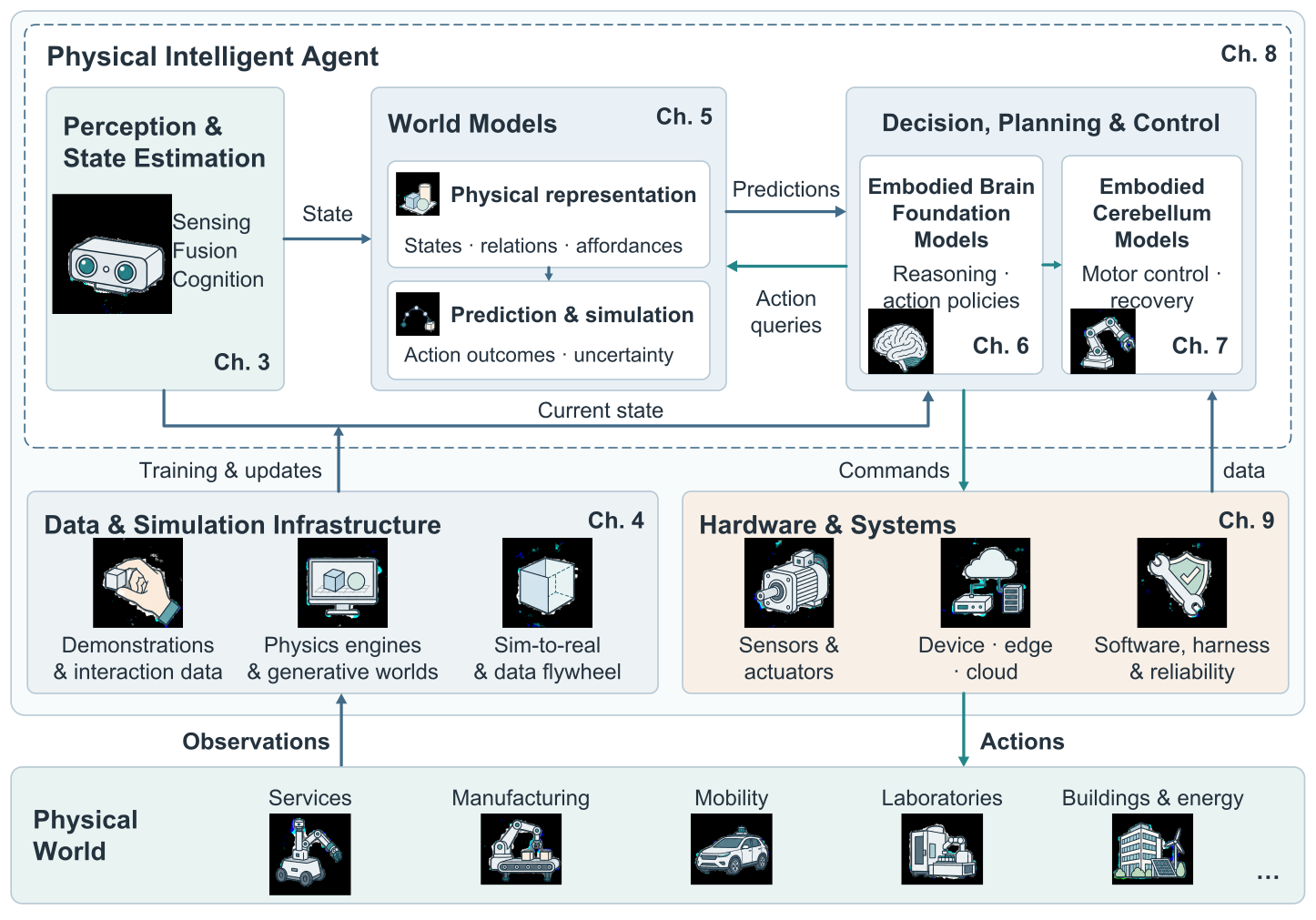
The Organizing Idea
Perception, prediction, decision-making, action, and adaptation form a continuous loop through the physical world.
An organizing framework introduced in Chapter 1.Estimate physical states from vision, touch, force, proprioception, and other sensing modalities.
Represent physical relationships and anticipate the consequences of possible actions.
Connect goals, planning, and control to feasible interventions in the physical world.
Verify outcomes, revise behavior, and learn across control, task, and deployment timescales.
Inside the Monograph
Three parts trace a path from concepts and foundations, through the technical stack, to future directions.
Select a chapter title for its overview, or expand the row to explore its sections.
Definitions, boundaries, and the foundations in physics, control, cognition, and learning.
The technical stack: perception, data, world models, manipulation, motor control, agents, and systems.
General physical intelligence, evaluation and governance, and long-term development strategies.
References p. 313
Chapter pages introduce the forthcoming content. Page numbers refer to the draft manuscript.
Authors
Physical Intelligence Team, Shanghai AI Laboratory
The monograph is authored by the Physical Intelligence Team, Shanghai AI Laboratory. It brings together the concepts, techniques, and challenges of intelligence that interacts with the physical world.
Individual author profiles and acknowledgments will be added when available.
Read & Explore
The preprint is coming soon. Companion materials will be shared here as they become available.
The preprint will be shared here when it is ready for public release.
A space for companion implementations and examples. Links will be added when available.
A space for chapter slides and teaching materials to accompany the monograph.
Corrections and a reader feedback channel will be added here when available.
Publication
The manuscript is being prepared for public release. Publication information will appear here.
Citation
This is a provisional citation for the forthcoming monograph.
Physical Intelligence Team, Shanghai AI Laboratory. Physical AI: Concepts, Techniques, and Challenges. Forthcoming, 2026.
@misc{physicalai2026monograph,
  title  = {Physical AI: Concepts, Techniques, and Challenges},
  author = {{Physical Intelligence Team, Shanghai AI Laboratory}},
  year   = {2026},
  note   = {Forthcoming; manuscript not yet publicly released}
}
The citation will be updated when the manuscript and final publication details are available.
Explore the table of contents while the preprint is being prepared for release.
Contact
For questions about the monograph and its companion materials.
Our contact email will be announced here.